
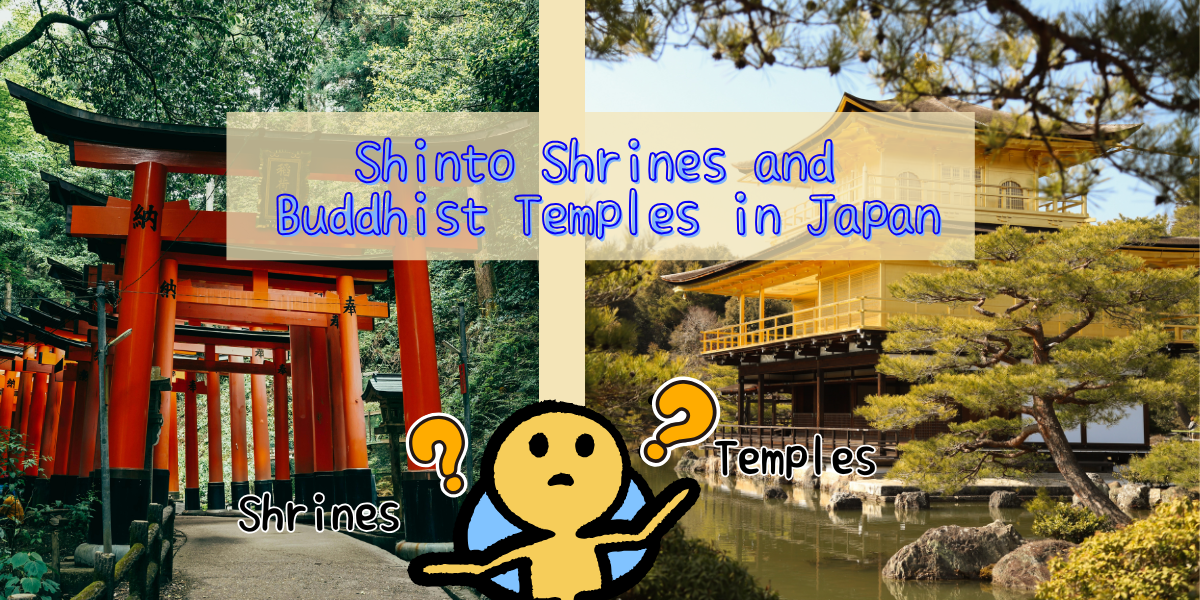
“What’s the difference between a Shinto shrine and a Buddhist temple?”
“How should I pray when I visit one?”
Kyoto is home to countless Shinto shrines and Buddhist temples. However, they can look quite similar at first, making it difficult for visitors to tell them apart.
In this article, I will explain the main differences between Shinto shrines and Buddhist temples, how to recognize them, the proper way to pray at each, and why Shinto and Buddhism are so closely connected in Japan.
By the end of this article, you will be able to visit shrines and temples with a better understanding of their differences and the traditions behind them.
Religion in Everyday Japanese Life
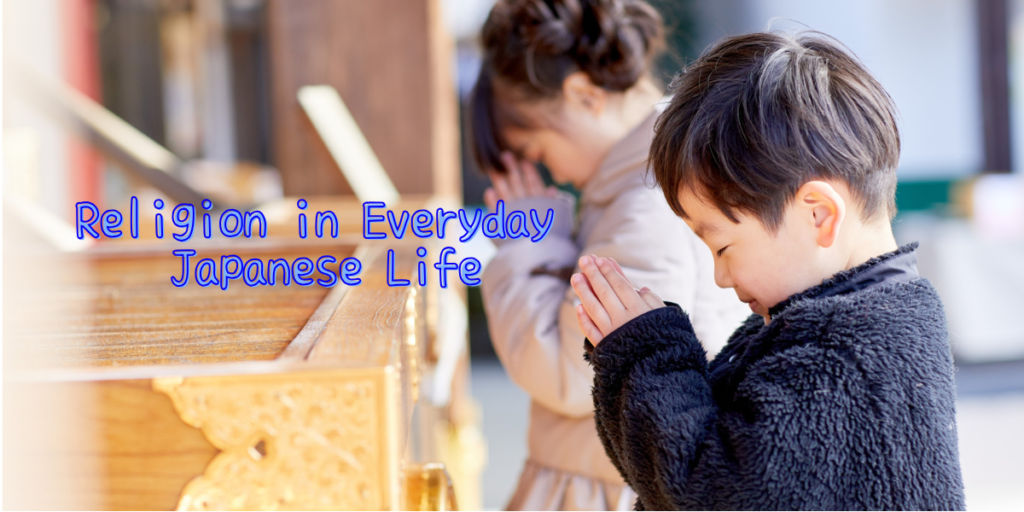
In Japan, many people take part in customs from different religions. They may visit both Shinto shrines and Buddhist temples without feeling that they have to choose between the two.
For example, people may visit a Shinto shrine or Buddhist temple for hatsumode at New Year.
Celebrations for children, such as omiyamairi and Shichi-Go-San, are often held at shrines, while funerals and memorial services are commonly Buddhist.
Many people also enjoy Christmas as a seasonal event, even if they are not Christian.
In Japan, religious customs are often closely connected with family traditions, annual events, and everyday life.
What Is the Difference Between a Shrine and a Temple?
Shinto shrines and Buddhist temples may look similar at first, especially to visitors who are unfamiliar with Japanese religions.
However, they belong to different religious traditions and have different objects of worship, buildings, religious figures, and prayer customs.
The table below shows some of the easiest ways to tell them apart.
| Shinto Shrine | Buddhist Temple | |
|---|---|---|
| Religion | Shinto | Buddhism |
| Who or what is worshipped | Kami—the sacred beings or presences worshipped in Shinto | Buddhas, bodhisattvas, and other Buddhist figures |
| Typical sacred object or image | A sacred object known as a goshintai, or sometimes a natural feature such as a mountain, rock, or tree | A Buddhist statue, painting, or mandala representing the principal object of devotion |
| Entrance | A torii gate | A roofed temple gate, sometimes called a sanmon or niomon |
| Religious figures | Shinto priests and miko shrine attendants | Buddhist monks or priests |
| Common features | Shimenawa ropeskomainu guardian animalsprayer halls | Buddhist statuesincense burnersbells |
| Common kanji in the name | 神社 (jinja),神宮 (jingu), 宮 (gū),大社 (taisha), 天満宮 (tenmangū) | 寺 (ji or dera) 院 (in) |
| Basic prayer style | Bow and clap | Place your hands together without clapping |
Because Shinto and Buddhism were deeply intertwined for over a millennium, some religious sites still display features of both traditions.
Look at the Entrance
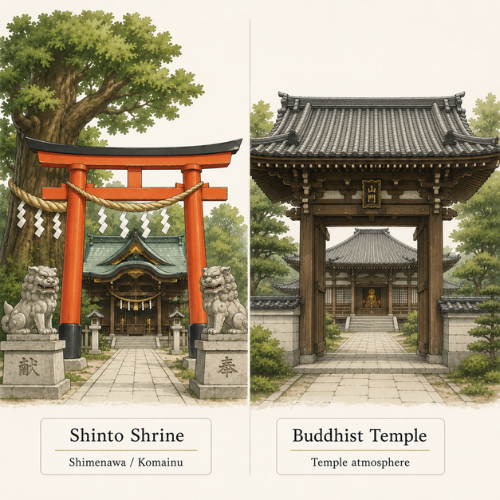
The entrance to a Shinto shrine is usually marked by a torii.
This simple gate marks the boundary between the ordinary world and the sacred space of the shrine.
Torii come in many sizes and styles. Some are made of wood and painted bright red, while others are made of stone, metal, or unpainted wood.
Buddhist temples usually have a roofed entrance gate.
The gate may be called a sanmon, while one containing two large Nio statues is called a niomon.
Temple gates often look more like small buildings than simple gates.
Look at the Sacred Objects and Images
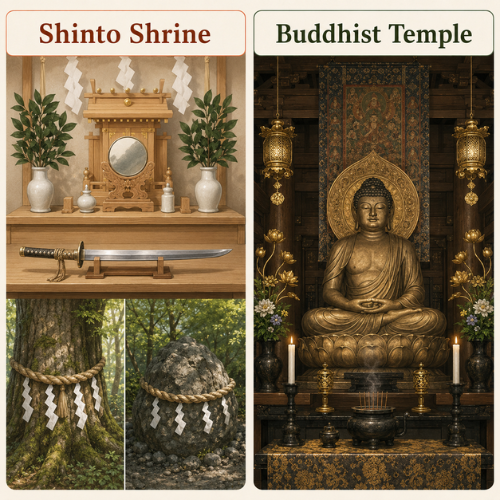
At a Shinto shrine, people worship kami.
The word kami is sometimes translated as “god” or “deity,” but it does not have exactly the same meaning as the single, all-powerful God of a monotheistic religion.
At Shinto shrines, kami are not usually represented by statues. Instead, a shrine may have a sacred object called a goshintai. It may be a mirror or sword kept out of public view, or a natural feature such as a mountain, rock, or tree.
At a Buddhist temple, the central object of devotion is called the honzon.
It may be a statue or painting of a Buddha, bodhisattva, or another Buddhist figure. In some Buddhist traditions, a mandala may also serve as an important object of devotion.
Buddhist statues are often visible inside the main hall, but this is not always the case. Some important Buddhist images are hidden from public view and are shown only on special occasions—or not at all.
Look at the People Who Serve There
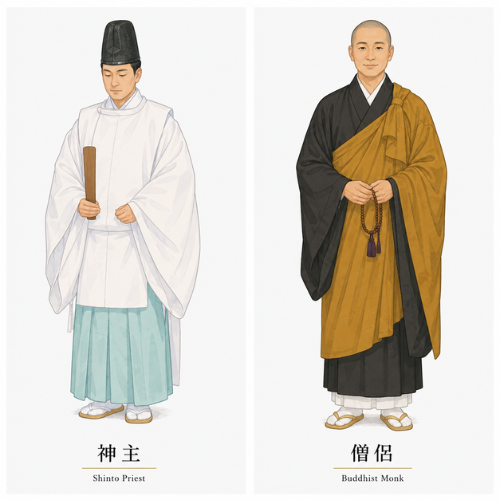
At a shrine, religious ceremonies are conducted by Shinto priests, who are often recognizable by their traditional clothing.
They commonly wear a white robe with hakama trousers. During ceremonies, they may also wear a wide-sleeved outer robe and black headwear called an eboshi.
You may also see miko, who usually wear white tops and red hakama.
Miko assist Shinto priests during ceremonies, perform sacred dances, and offer amulets and other items to visitors. They are shrine attendants and should not be confused with female Shinto priests.
At a Buddhist temple, ceremonies and religious duties are performed by Buddhist monks or priests.
They usually wear traditional Buddhist robes. Many monks have shaved heads, although this varies depending on the Buddhist tradition and the individual.
Look at Other Features
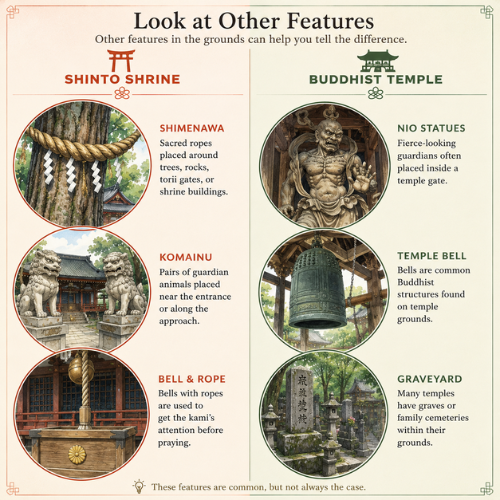
You can also tell shrines and temples apart by looking at the objects and buildings around the grounds.
At a Shinto shrine, you may see:
- Shimenawa — sacred ropes placed around trees, rocks, torii gates, or shrine buildings
- Komainu — pairs of guardian animals placed near the entrance or along the approach
Some shrines have foxes, cattle, rabbits, or other animal statues instead of komainu. The animal often has a special connection with the kami worshipped at the shrine.
At a Buddhist temple, you may see:
- Incense burners — places where visitors offer incense before praying
- Bells and pagodas — common Buddhist structures found on temple grounds
- Nio statues — fierce-looking guardians often placed inside a temple gate
- Graveyards — many temples have graves or family cemeteries within their grounds
Check the Name
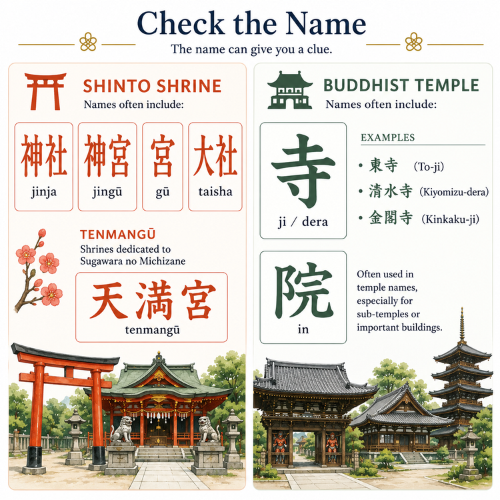
The name of a religious site can also provide a useful clue.
Shinto shrine names often contain the following words:
- 神社 (jinja) — shrine
- 神宮 (jingu) — imperial shrine
- 宮 (gu) — shrine
- 大社 (taisha) — grand shrine
- 天満宮 (tenmangu) — a shrine dedicated to Sugawara no Michizane, the deity of learning
For example, Kyoto has Fushimi Inari Taisha, Heian Jingu, Yasaka Jinja, and Kitano Tenmangu.
Buddhist temple names often contain the following characters:
- 寺 (ji or dera) — temple
- 院 (in) — temple or religious institution
Examples include To-ji, Kiyomizu-dera, Kinkaku-ji, Byodo-in, and Chion-in.
However, names are not a perfect guide. Some temples are better known by nicknames, while others do not include 寺 or 院 in their commonly used names.
To identify a site, consider its name, entrance, buildings, and sacred objects together rather than relying on a single clue.
How to Visit Shrines and Temples
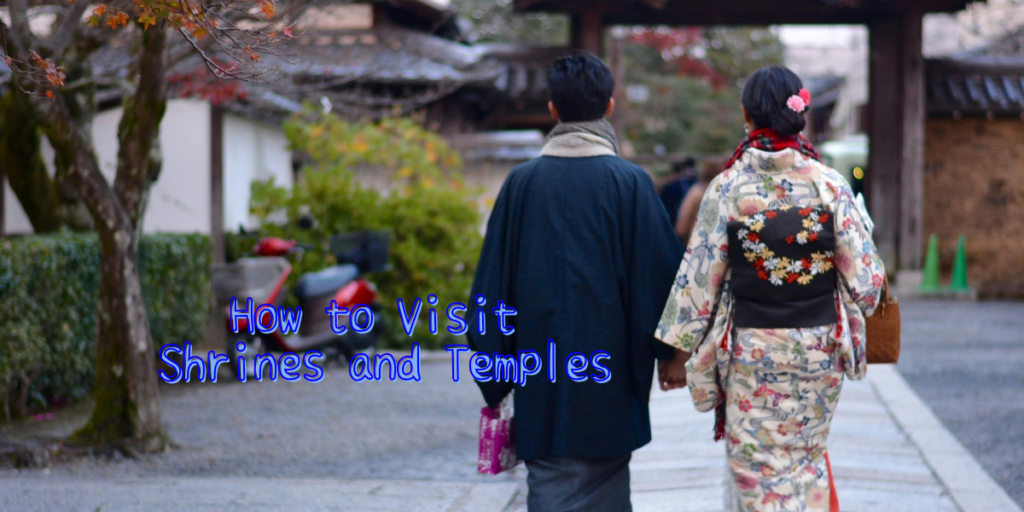
Kyoto has hundreds of shrines and temples, and each one is an important place of worship—not simply a sightseeing attraction.
When visiting, speak quietly, follow any signs, and avoid touching statues, buildings, or other sacred objects unless visitors are clearly invited to do so.
Photography is allowed in many outdoor areas, but it may be prohibited inside halls or near important sacred objects.
You do not need to perform every step perfectly. Showing respect is more important than worrying too much about making a small mistake.
How to Pray at a Shinto Shrine
The following is the standard way to pray at most Shinto shrines in Kyoto.
A torii marks the entrance to the sacred grounds. Stop briefly and make a small bow before entering.
After passing through the torii gate, it is considered polite to walk slightly to one side of the approach rather than directly along the center. The center is traditionally regarded as the path of the kami.
If water and ladles are available, follow these steps:
- Hold the ladle in your right hand and rinse your left hand.
- Move the ladle to your left hand and rinse your right hand.
- Hold it in your right hand again, pour a little water into your left hand, and use it to rinse your mouth. Do not touch the ladle directly to your lips.
- Rinse your left hand once more.
- Finally, tilt the ladle upright so that the remaining water runs down the handle, then return it to its original place.
At the worship hall, place a coin in the offering box. There is no required amount.
Some shrines have a large bell attached to a rope in front of the worship hall. Ring it gently before praying.
Make two deep bows, clap your hands twice, and offer your prayer quietly. Finish with one more deep bow.
When leaving, it is polite to turn toward the shrine and bow once more before passing through the torii gate.
How to Pray at a Buddhist Temple
Customs vary depending on the temple and Buddhist tradition, but the following is a simple guide that can be used at many temples in Kyoto.
Stop briefly in front of the gate and make a small bow before entering the temple grounds.
Some temples have a temizuya, similar to those found at Shinto shrines. If one is provided, rinse your hands and mouth before approaching the main hall.
If water and ladles are available, follow these steps:
- Hold the ladle in your right hand and rinse your left hand.
- Move the ladle to your left hand and rinse your right hand.
- Hold it in your right hand again, pour a little water into your left hand, and use it to rinse your mouth. Do not touch the ladle directly to your lips.
- Rinse your left hand once more.
- Finally, tilt the ladle upright so that the remaining water runs down the handle, then return it to its original place.
At some temples, visitors can purchase candles or incense and offer them before praying. This is optional.
There is no required amount. Place the coin in the box quietly rather than throwing it forcefully.
Do not clap your hands.
Clapping is part of the usual prayer ritual at Shinto shrines, but it is generally not done at Buddhist temples.
When leaving the temple grounds, it is polite to turn toward the main hall and bow once more at the gate.
Why Are Shinto and Buddhism So Closely Connected?
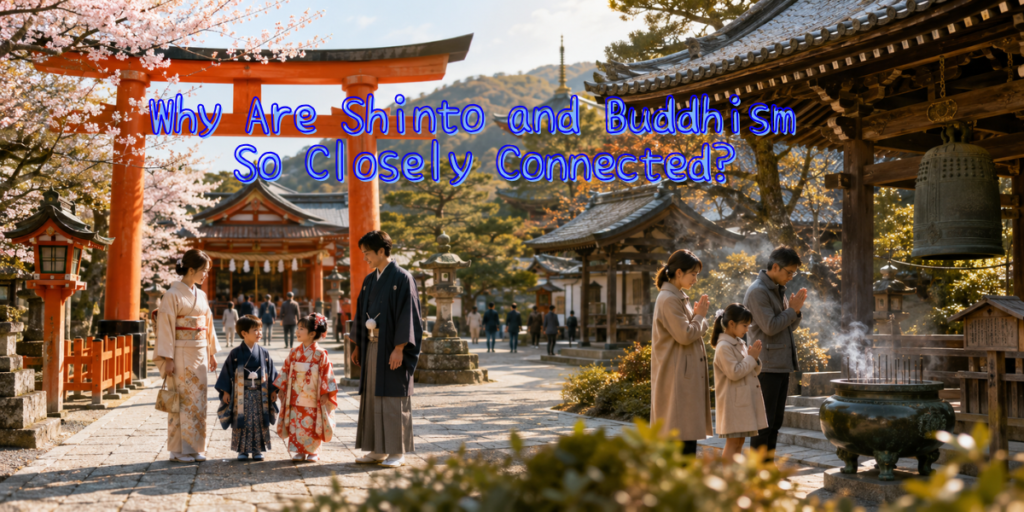
Today, Shinto shrines and Buddhist temples are officially separate religious institutions.
However, for much of Japanese history, the boundary between Shinto and Buddhism was not so clear.
To understand why many Japanese people still visit both shrines and temples, it helps to look briefly at how the two traditions developed together.
Shinto Beliefs Before Buddhism Arrived
Before Buddhism arrived, people in Japan already worshipped kami associated with nature, particular places, ancestors, and important figures.
Mountains, rivers, waterfalls, trees, and rocks could be regarded as sacred or connected with the presence of a kami.
This idea is often expressed by the phrase yaoyorozu no kami, usually translated as “countless kami.” Although the expression literally means “eight million,” it refers to an uncountable number of kami.
Buddhism Arrived in Japan
Buddhism originated in India and reached Japan through continental Asia and the Korean Peninsula. It is generally believed to have arrived in Japan during the sixth century.
The new religion did not completely replace Japan’s existing beliefs in kami. Instead, Buddhist teachings were gradually accepted alongside local traditions.
Rather than choosing one tradition and rejecting the other, people found ways for Buddhism and the worship of kami to exist together.
Shinto and Buddhism Became Intertwined
Over the centuries, Shinto and Buddhism became deeply intertwined. This blending of the two traditions is known as shinbutsu shūgō, or the syncretism of Shinto and Buddhism.
Buddhist halls and pagodas were sometimes built within shrine grounds, while shrines dedicated to kami could also be found within Buddhist temple complexes.
In some traditions, kami were understood as manifestations of Buddhas and bodhisattvas, or as protectors of Buddhism.
For many centuries, people did not always make a clear distinction between worshipping kami and worshipping Buddhist figures. Both traditions formed part of the same religious landscape.
The Separation of Shinto and Buddhism
In 1868, at the beginning of the Meiji period, the new government introduced policies to formally separate Shinto and Buddhism.
Buddhist objects and buildings were removed from many shrines, and religious sites that had previously combined both traditions were reorganized as either shrines or temples.
Although shrines and temples are now officially separate, more than a thousand years of coexistence cannot be completely erased.
The influence of both traditions can still be seen in religious sites, local festivals, family customs, and the way many Japanese people visit both shrines and temples today.
Shinsenen in Kyoto—A Buddhist Temple with a Torii Gate
Shinsenen is located near Nijo Castle in Kyoto and is now a Buddhist temple of the Toji Shingon school.
However, visitors entering from the south will first see a large stone torii gate, a feature usually associated with Shinto shrines.
With both Buddhist buildings and a shrine dedicated to a kami within the same grounds, Shinsenen is one of Kyoto’s unusual places where visitors can still see traces of Japan’s long history of Shinto and Buddhist coexistence.
Final Thoughts

Shinto shrines and Buddhist temples belong to different religious traditions, but they have existed side by side in Japan for centuries.
This long history is one reason why many Japanese people visit both without seeing the two traditions as contradictory.
Here are the main points to remember:
- Shrines are dedicated to kami, while temples are dedicated to Buddhas and bodhisattvas.
- A torii usually marks a shrine, while temples often have roofed gates and Buddhist statues.
- At shrines, bow twice, clap twice, and bow once; at temples, pray without clapping.
- Shinto and Buddhism were closely connected for centuries.
- Respect is more important than performing every step perfectly.
When traveling in Kyoto, look for these differences and discover the depth of Japanese culture. Understanding what you see will make your visit more meaningful—and perhaps even more memorable.

コメント